
Heat Pump & Ductless Installation in Seattle, WA
Ducted and ductless heat pumps for Seattle homes. Free written quotes, permits pulled under my own licence, and the same person on the quote and on the install.
A heat pump replaces your furnace and your air conditioning with one system. A ductless mini-split is that same heat pump built for a house that has no ducts to feed — and in Seattle, a great many houses have no ducts.
ExactAir Home Comfort is one person: me, Rylan Utter. I am based in Everett, not in Seattle, and I would rather say that plainly than dress it up. Seattle is inside the area I serve and I take work there, but I am not round the corner and I am not going to pretend otherwise. What you get instead is that the person who quotes your job is the person who installs it, and there is no commissioned salesman in between.
What it costs in Seattle — how pricing works
I do not put prices on a webpage, because your house sets the number. I walk the house, run the load calculation, and give you a free written quote with good, better and best options side by side. These are the systems I install most:
- American Standard 2-ton heat pump, side discharge, multi-stage
- Free written quote after a site visit
- Ameristar 80,000 BTU 80% gas furnace, like-for-like replacement
- Free written quote after a site visit
- A/C coil added during a furnace install (makes the system heat-pump ready)
- Free written quote after a site visit
- Honeywell S1200 smart thermostat
- Free written quote after a site visit
- Ecobee Smart Thermostat Premium
- Free written quote after a site visit
- Air Scrubber UV whole-home purification
- Free written quote after a site visit
- Multi-zone ductless
- priced at the site visit — head count decides it
You will notice there is no multi-zone ductless number on that list. That is deliberate. A single head in a bonus room and a five-head system running a whole house are not the same job, they are thousands of dollars apart, and a headline price for “ductless” would only ever be honest for one of them.
What sets the price is your house. A crawlspace you cannot stand up in. An electrical panel with no space left in it. A line set that has to run three times its normal length because the only place the outdoor unit can sit is round the far side of the building. Any one of those moves the number, and I would much rather tell you at your kitchen table than discover it on day two.
So there is no starting-at figure that quietly doubles. I look at the house, I write the number, and the number is the number. There is a 5% discount for active military, veterans and first responders, and financing is available.
Why so many Seattle houses end up ductless
Houses built before central heating was standard were not built with anywhere to put ducts, and a large share of Seattle's housing predates it. Neither were most of the additions, converted attics and bonus rooms that got added later — which is why so many Seattle houses have one room that has never been the right temperature in either season.
Retrofitting ducts into a finished house is not really an HVAC job. It is a carpentry job with an HVAC job at the end of it — dropped ceilings, lost closet depth, patched and repainted drywall — and you pay for all of that before you have paid for a single BTU of heat. In a house with plaster walls and no attic to work in, that carpentry can cost more than the mechanical equipment it exists to serve.
Ductless skips the problem rather than solving it. One outdoor unit, a three-inch penetration through the wall, and heads only in the rooms that need them. One head for the room over the garage. Four or five on a single outdoor unit for a house that has never had central anything.
The honest counterweight, because it matters more than the sales pitch: if your house already has sound ducts, ducted is normally the better system. It is out of sight, everything filters through one filter, and it costs less per square foot of house. If someone recommends ductless without looking in your crawlspace first, they have not answered the question — they have quoted the thing they had in the van.
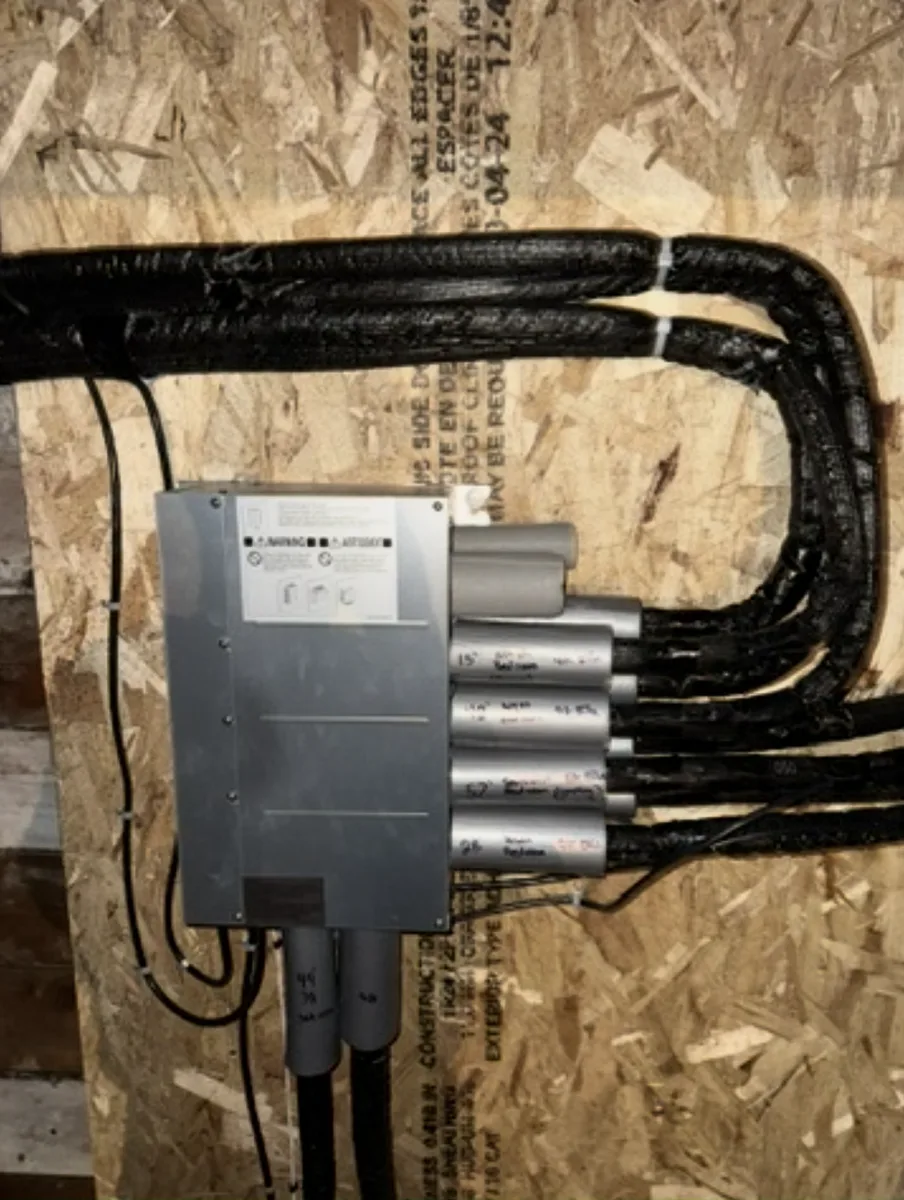
Will a heat pump actually keep a Seattle house warm?
Yes. The equipment I install is cold-climate inverter equipment, rated to keep producing heat into negative temperatures. Seattle does not get there.
The doubt is fair, because it used to be true. Heat pumps from twenty years ago shed most of their output as the outdoor temperature dropped, which is why so many Puget Sound houses ended up with electric strip heat bolted on behind them, and why plenty of people still remember a heat pump as the thing that ran all night and never really warmed the house.
Inverter equipment changed that. The compressor varies its speed instead of banging on and off, so it holds capacity much further down the temperature range and spends most of its life running slowly. Running slowly is what makes it quiet — which matters more in a mini-split than in a ducted system, because the indoor head is in the room with you rather than down in a crawlspace.
Seattle's problem was never extreme cold anyway. It is the length of the season: a long, wet, forty-degree winter where the heat is on for months. That is the exact condition a heat pump is best at and a furnace is worst at, because a furnace only knows full blast and off.
One thing worth asking when you are comparing quotes: get the rated heating capacity at 17°F and at 5°F for the specific outdoor unit being proposed. It is printed on the manufacturer's data sheet. A contractor who will not show it to you has told you something useful.
Ducted, ductless, or both — what I'd put in your house
There are three honest answers and they depend on the house, not on what I would rather sell.
Ductless on its own. No usable ductwork, or ductwork that only serves half the house. Heads go where the rooms are, and you can stage it — do the two rooms that are actually a problem now, add to the same outdoor unit later if it was sized for it. Ask about that sizing before you buy, because it is the decision that either leaves the door open or closes it.
A ducted heat pump. If the ducts are sound and the panel has capacity, this is usually the better system and often the cheaper one per square foot. One unit outside, one inside, heating and cooling from the same equipment.
Both, on one house. More common than people expect. Ducted equipment handles the original part of the house, a head or two handles the addition the ducts never reached properly. It is not a bodge; it is the right tool in each half of the building.
And there is a fourth answer that costs you nothing: the system you have has another season in it. I will tell you that too. I would rather come and look at it again next August than sell you something you did not need this week.
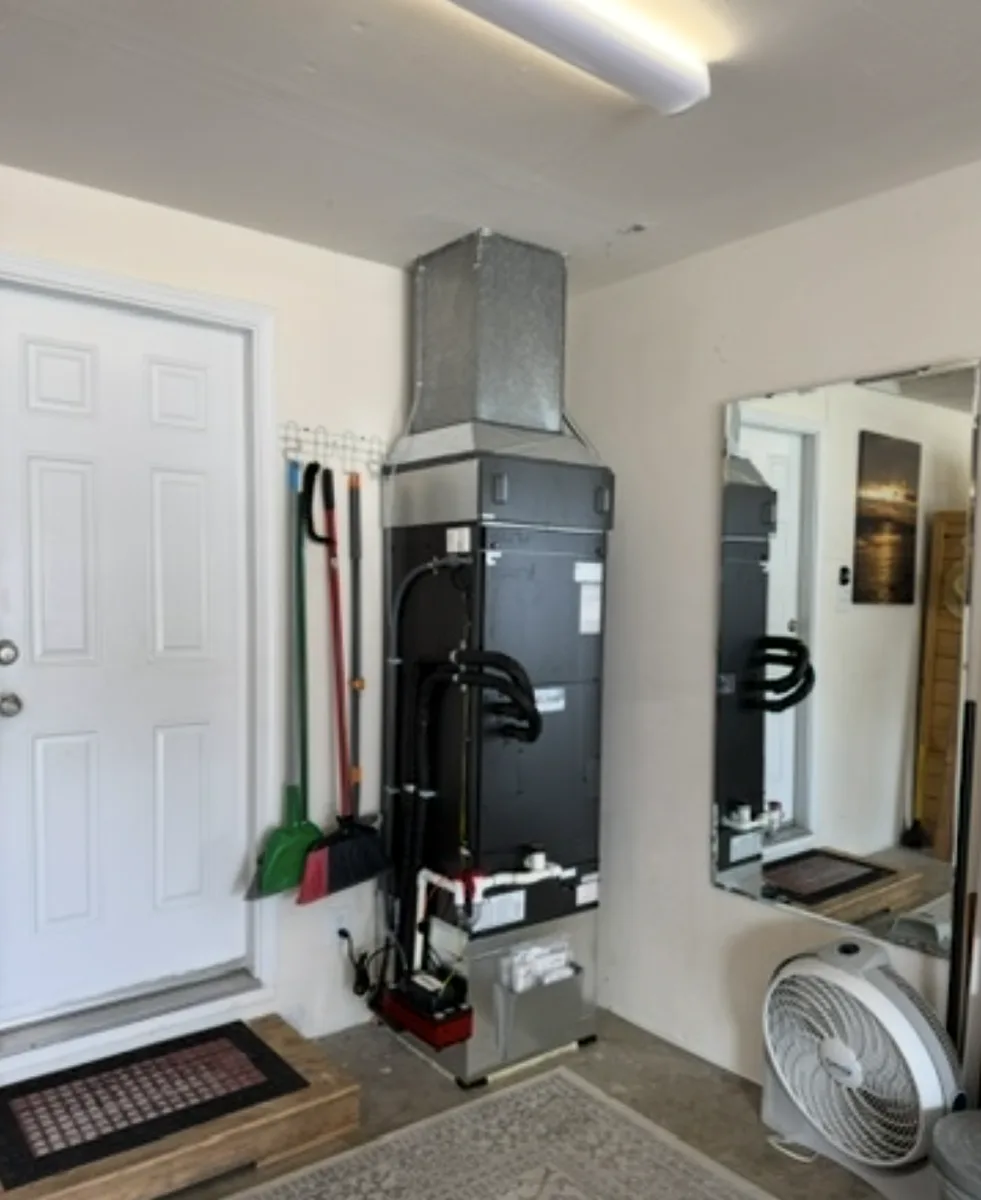
What the install actually involves
Most jobs run two to four days. Head count and how the building is put together decide it, not the size of the equipment.
- Before anything — the site visit
- I measure the house and run a load calculation. Not square footage off the listing. I look at the panel, the crawlspace, the ducts if there are any, where the outdoor unit can physically go, and how the line set gets there without running across the front of your house.
- Day one — the old system out, or the heads settled
- Old equipment removed and refrigerant recovered properly rather than vented. On a ductless job this is when exactly where each head goes gets settled on the wall before anything is cut, because a head in the wrong wall is something you look at every day for twenty years.
- Day one to two — the new system in
- Outdoor unit set on a level pad with proper clearances and vibration isolation. Line sets run, penetrations sealed, exterior line-hide kept straight and tight to the building rather than looping across the siding. Condensate routed somewhere that will still make sense in ten years, and a weatherproof disconnect within sight of the unit, sized and grounded to code.
- Day two to three — vacuum and charge
- The refrigerant circuit is pulled down to a deep vacuum and charged to specification. This is the step that decides whether the system runs for twenty years or fails in its third summer.
- Last — commissioning and the walk-through
- System run, airflow and charge verified, controls configured for your specific equipment, and then I show you how to actually use it. Most people never touch half of what they paid for because nobody sat down and explained it.
The step that decides whether the system lasts is the vacuum and the charge, and it is the one nobody watching from the kitchen can evaluate. That is where a refrigeration journeyman's licence stops being a line on a website.
Permits in Seattle — a different jurisdiction from my Snohomish work
I hold a general contractor's licence as well as a refrigeration journeyman's licence, which means I pull the permit myself instead of subbing it out or quietly leaving it off the quote.
Seattle is King County, and the mechanical permit goes through the City of Seattle rather than through Snohomish County the way most of my work does. The fee is set by the city, so it is a real line on your quote and I will have the actual figure for you at the site visit — not a number I guessed on a webpage in August.
Why it matters more than it sounds: an unpermitted install is the thing that surfaces when you sell the house, and unpermitted electrical work is the thing your insurer asks about after a fire. It also means somebody other than me looks at what I did, which is the point.
A multi-zone ductless job, in the customer's words
This is a Google review, quoted exactly as it was written. It names no city, and I am not going to pretend it does — but a five-zone ductless system in a 1930s house is the Seattle job description almost word for word:
“I am extremely satisfied with ExactAir. Most other companies have expensive quotes and used high pressure sales tactics. Rylan was able to immediately set himself apart with genuine conversation and upfront expectations and pricing.”
“Rylan installed a 5-zone minisplit in our 1930s home. He is the real deal; extremely passionate, knowledgeable, and most importantly, he cares. The system is sized appropriately for our home, and the installation work looks fantastic! I cannot recommend him enough. You will not be disappointed.”
— Alex Gebhart, 4 July 2026
Rebates and tax credits — what I'll tell you, and what I won't
I am not putting a rebate figure on this page.
Utility programmes and tax credits change, they have eligibility rules that turn on your exact address and on how your house is heated today, and a number I type in August is worth nothing to you in February. Seattle makes that worse rather than better: it is a different county and a different utility from most of the area I work in, so a programme that applied to a house I worked on last month may have nothing to do with yours.
What I will do instead is tell you at the site visit what actually applies to your address and what it is worth — including when the answer is nothing — and then you should go and verify it yourself before you plan around it. That is a better use of your money than trusting a webpage, mine included.
The cooling half nobody asks about
Everyone buys a heat pump for the heat. Then July arrives.
A heat pump is an air conditioner that also runs backwards. There is no separate cooling equipment to buy, no second outdoor unit, no extra install. For most of the houses I work in, the heat pump is the first air conditioning that house has ever had.
This is a bigger deal in a house with no ductwork than in one that has it. A house with no ducts has usually never had any way to cool itself at all beyond opening windows and buying a box fan every few years, and a top floor under a dark roof is the room where that stops being an inconvenience and starts being a sleep problem. The mini-split solves something the owners had stopped thinking of as solvable.
Jobs I can show you — and where they are
I am not going to show you a Seattle job on this page, because I do not have one photographed and captioned that I can stand behind. Putting somebody else's install under a Seattle heading is the sort of thing this trade does constantly and I would rather lose the enquiry.
What I can show you is real, photographed work of exactly the kind described above. The nearest documented job to Seattle is a heat pump installation in Kirkland where the outdoor unit went underneath the homeowner's deck — the obvious locations would all have eaten into the patio, so the system got designed around the house instead of the other way round, with the airflow clearance and service access it still needs.
If you want a Seattle reference before you commit, ask me on the phone. That is a fair question and I will answer it straight.
Who is actually turning up
Rylan Utter. About six years in the trade, and ExactAir has been mine since November 2024.
I hold a general contractor's licence and a refrigeration journeyman's licence. Installs are the work I care about and the work I am best at — I quote them, I do them, and I am the one you call afterwards if something is not right.
I am open 7am to 8pm, seven days a week, and the number on this page is my cell. When you call at 7:40 on a Sunday evening you get me, not an answering service taking a message for Monday.
Every review on my Google profile is a five-star review. I would like to keep it that way, which is a better guarantee of how your house gets treated than anything else I could write here.
Common questions
Do you actually come out to Seattle? Yes. I am Everett-based, so I am not going to claim I am ten minutes away — but Seattle is inside the area I serve and I quote and install there.
How long does a ductless installation take? Two to four days on most houses. Head count and how the building is put together decide it, not the size of the outdoor unit.
How many indoor heads do I need? Fewer than most people are quoted. A head per room is a way to sell equipment, not a way to design a system. I would rather solve the rooms that are actually a problem and leave you the option to add later.
Will my electrical panel handle it? That is one of the first things I check. If it will not, you hear about it before you get a price, not after you have signed.
Can I keep my gas furnace and add ductless? Yes, and for some houses that is the cheapest good answer — the furnace keeps doing what it already does and the heads solve the rooms it never reached.
Are they loud? An inverter system spends most of its life at low speed. Indoor heads are quiet; where the outdoor unit gets placed matters more than which badge is on it.
Do you do the work yourself? Yes. Every time.
What if the answer is that I don't need a new system? Then that is what I will tell you, and it costs you nothing.
HVAC services & nearby areas
Our services in Seattle
Nearby cities we serve
Ready to upgrade your home comfort in Seattle?
Honest pricing, straight answers, and no high-pressure sales. Get your free quote from Rylan, the owner — the person who quotes your job is the person who installs it — plus a 5% discount for military, veterans & first responders.