
Heat Pump Installation in Snohomish, WA
One system that heats through the valley winter and cools through August, sized by load calculation and quoted in writing. Snohomish is a short run east of where I am based.
A heat pump replaces both the furnace and the air conditioner with one piece of outdoor equipment that moves heat in either direction. For a Snohomish property beyond the gas main it is usually not a close call, and for a historic downtown house with no ducts the answer is normally ductless rather than no.
What a heat pump costs in Snohomish — how pricing works
I do not put prices on a webpage, because your house sets the number. I walk the house, run the load calculation, and give you a free written quote with good, better and best options side by side. These are the systems I install most:
- American Standard 2-ton heat pump, side discharge, multi-stage
- Free written quote after a site visit
- A/C coil added during a furnace install (makes the system heat-pump ready)
- Free written quote after a site visit
- Ameristar 80,000 BTU 80% gas furnace, like-for-like replacement
- Free written quote after a site visit
- Honeywell S1200 smart thermostat
- Free written quote after a site visit
- Ecobee Smart Thermostat Premium
- Free written quote after a site visit
- Air Scrubber UV whole-home purification
- Free written quote after a site visit
- Mechanical permit
- Free written quote after a site visit
What sets the price is your house. A period place off First Street with plaster walls and a crawlspace you cannot stand up in is not the same job as a modern house out towards Cathcart, and neither is the same as a property on acreage where the only sensible spot for the outdoor unit is a long way from the electrical panel. Line set length, panel capacity, duct condition: any one of them moves the number.
So there is no starting-at figure that quietly doubles once the work has begun. I look at the house, I write the number, and the number is the number. If you want options you get good, better and best in writing, and I will tell you what the extra money actually buys — which on some jobs is nothing worth having. There is a 5% discount for active military, veterans and first responders, and financing is available.
Off the gas main — the question most of the valley is actually asking
Snohomish stops being a town and starts being a valley about two minutes outside downtown. Out towards Three Lakes, Cathcart and Machias there are a lot of properties with no natural gas service, and for those houses the comparison is not heat pump versus gas furnace at all. It is heat pump versus electric resistance heat, or versus propane.
Against electric resistance heat this is the easiest version of the decision there is. Resistance heat turns a unit of electricity into a unit of heat and can never do better than that. A heat pump moves heat rather than making it, so it delivers several units of heat for the same electricity. Against propane the arithmetic depends on what you are paying per gallon this year, but the direction of it does not change.
And you stop having a fuel delivery in your life — no tank, no schedule, no winter price. On a property at the end of a long drive that is often worth as much as the running-cost difference.
A downtown house with no ducts is not a lost cause
The houses along and around historic First Street are most of the reason people love Snohomish and most of the reason their heating is a compromise. Many were built long before central ductwork was standard. Adding ducts to one of them is not really an HVAC job — it is a carpentry job with an HVAC job at the end of it, and in a plaster-walled house with no attic to work in that carpentry can cost more than the mechanical equipment it exists to serve.
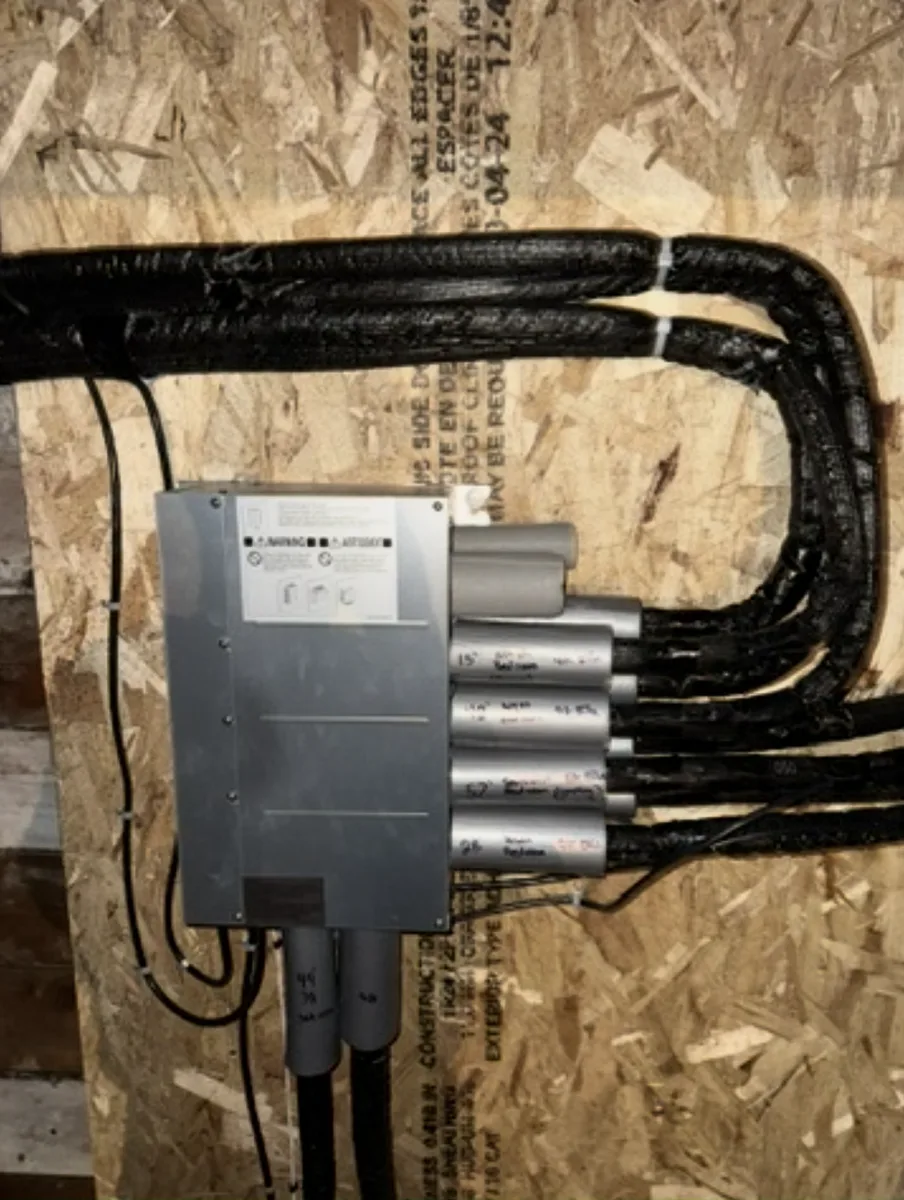
Ductless skips the problem rather than solving it. One outdoor unit, a three-inch penetration through the wall, and heads only in the rooms that actually need them. It is still a heat pump — same technology, same efficiency, same ability to cool in August — it just does not need the ducts the house never had.
It is also the version that leaves a period interior alone, which for a downtown Snohomish house is usually the whole point.
Will a heat pump actually keep a Snohomish house warm?
Yes. The equipment I install is cold-climate inverter equipment, rated to keep producing heat into negative temperatures. The valley does not get there.
The doubt is fair, because it used to be true. Heat pumps from twenty years ago shed most of their output as the outdoor temperature dropped, which is why so many houses around here ended up with electric strip heat bolted on behind them, and why plenty of people still remember a heat pump as the thing that ran all night and never really warmed the house.
Inverter equipment changed that. The compressor varies its speed instead of banging on and off, so it holds capacity much further down the temperature range and spends most of its life running slowly. Running slowly is what makes it quiet, and it is also what holds the house at one temperature rather than swinging four degrees either side of the setpoint the way a single-stage furnace does.
The valley's problem was never extreme cold anyway. It is the length of the season — a long, wet, forty-degree winter with the heat on for months, plus the fog that sits on the river bottom well after everywhere else has cleared. That is the exact condition a heat pump is best at and a furnace is worst at, because a furnace only knows full blast and off.
One thing worth asking when you are comparing quotes: get the rated heating capacity at 17°F and at 5°F. It is printed on the manufacturer's data sheet for whatever is being proposed. A contractor who will not show it to you has told you something useful.
The three things that decide whether it can be done at all
Before equipment, before brand, before price, three things about your house decide what is possible. I check all three at the site visit and you hear the answer before you get a number, not after you have signed.
- The electrical panel
- A heat pump needs a dedicated circuit and the panel needs room for it. On an older downtown house, or on a property that has been added to over forty years, this is the constraint more often than not — and a service upgrade is a real cost that belongs in the conversation at the start rather than in a change order.
- The ductwork
- Undersized or leaky ducts throttle a new system no matter what you paid for it, and a heat pump moves more air at a lower temperature than the furnace it replaced — so ducts that were adequate before may not be. I would rather fix that than sell you equipment that cannot perform.
- Where the outdoor unit can physically sit
- It needs clearance, a level pad, a sensible line set run, and somewhere for condensate to go. On acreage that is rarely a constraint; on a narrow downtown lot it occasionally decides the whole design.
What the install actually involves
Most jobs run two to four days.
- Before anything — the site visit
- I measure the house and run a load calculation. Not square footage off the listing. I look at the panel, the crawlspace, the ducts, where the outdoor unit can go, and how the line set gets there without running across the front of your house.
- Day one — the old system out
- Old equipment removed and refrigerant recovered properly rather than vented. On most jobs this is also when the sheet-metal transitions get fabricated to fit what is actually there, because what is actually there is never what the catalogue drawing shows.
- Day one to two — the new system in
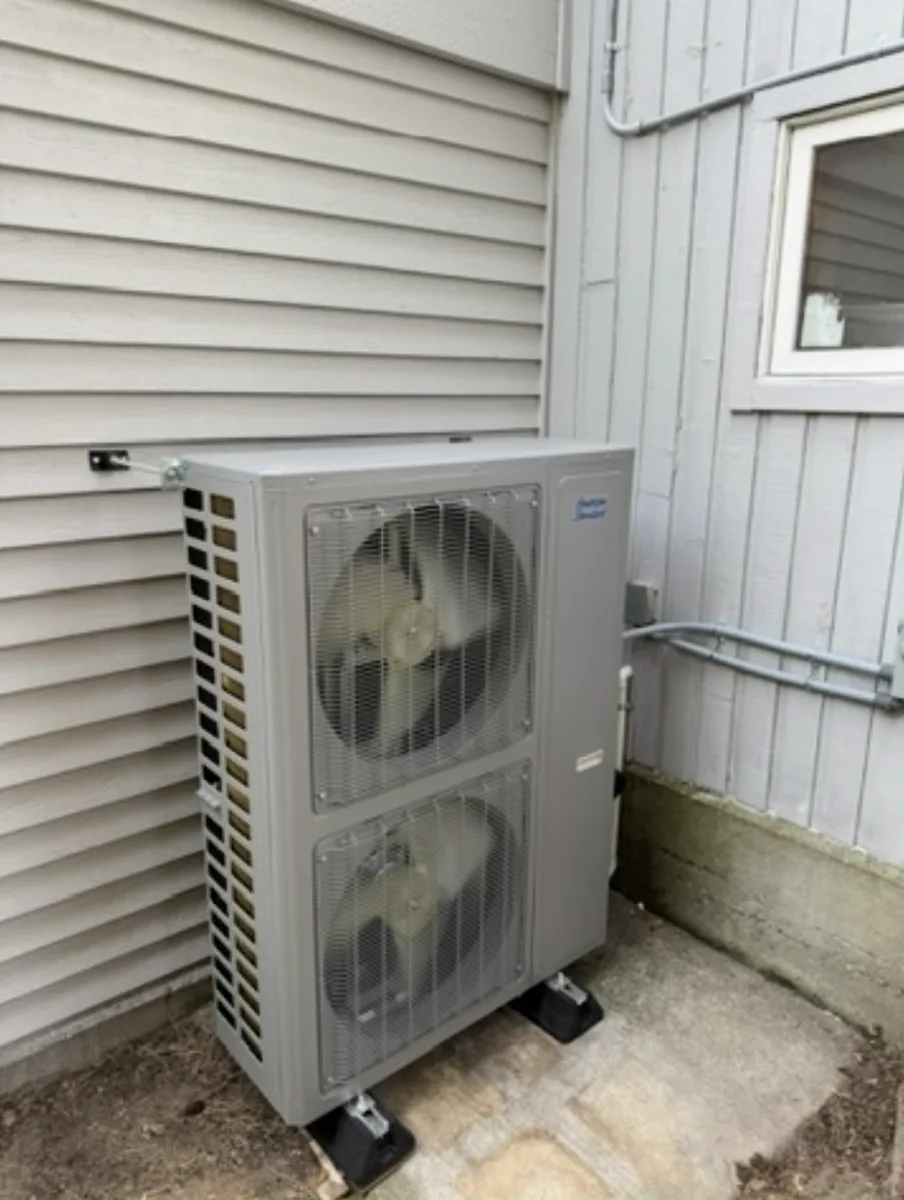
- Outdoor unit set on a level pad with proper clearances and vibration isolation. Indoor unit set and connected with the transitions sealed. Line set run, condensate routed somewhere that will still make sense in ten years, and a weatherproof disconnect within sight of the outdoor unit, sized and grounded to code.
- Day two to three — vacuum and charge
- The refrigerant circuit is pulled down to a deep vacuum and charged to specification. This is the step that decides whether the system runs for twenty years or fails in its third summer.
- Last — commissioning and the walk-through
- System run, airflow and charge verified, thermostat configured for your specific equipment, and then I show you how to actually use it.
The part that decides whether the system lasts is the vacuum and the charge, and it is the one nobody watching from the kitchen can evaluate. It is also the step that gets rushed when a crew has another job booked that afternoon.
Permits, and why I pull my own
I pull the permit myself rather than subbing it out or quietly leaving it off the quote. The mechanical permit is a line on your written quote from the start, so it is never a surprise on the invoice.
That figure is the Snohomish County one, and Snohomish is where it applies. It is a genuine difference from my King County work, where the fee is set by the city and I will not print a number I have not verified.
An unpermitted install is the thing that surfaces when you sell the house, and unpermitted electrical work is the thing your insurer asks about after a fire. It also means somebody other than me looks at what I did, which is the point.
If the heat has already gone
Plenty of people end up reading a page about heat pump installation because something has already failed and they are working out whether this is a repair or the beginning of a much larger conversation.
If the house is cold, make the call first and read afterwards. I answer my own phone from 7am to 8pm, seven days a week, and Snohomish is one of the closer places on my list. I would rather tell you honestly when I can be there than have you plan around a promise printed on a website.
It is also worth saying that a no-heat call does not have to end in a replacement. Rich St. Thomas, 24 May 2026, quoted exactly as it was written: “Tested everything and then gave me not only the diagnosis but gave me 4 separate options on what I can do from replacing bad parts in old furnace all the way to upgrading to a new furnace and heat pump.” Four options, including the cheap one.
Rebates — what I'll tell you, and what I won't
I am not putting a rebate figure on this page.
Utility programmes and tax credits change, they turn on your exact address and on how your house is heated today, and a number typed here this month is worth nothing to you in February. Two houses on the same road can get different answers depending on how they are heated now.
I will tell you at the site visit what actually applies to your address and what it is worth — including when the answer is nothing — and then you should verify it yourself before you plan around it. That is deliberately less exciting than a headline figure, and it is the version that is still true in six months.
Who is actually turning up
ExactAir Home Comfort is one person: me, Rylan Utter. I am based in Everett, a short run west, and Snohomish is one of the closest places on my list — which is why a no-heat call here gets answered quickly rather than scheduled for next week.
The person who quotes your job is the person who installs it. There is no salesman, no crew you have not met, and no handover. I am reachable 7am to 8pm, seven days a week.
Heat Pumps FAQs
Yes. Modern cold-climate heat pumps maintain strong heating output well below freezing, which covers the vast majority of Snohomish winter conditions. For extreme cold snaps we can add backup heat in a dual-fuel setup.
For most homes replacing electric resistance heat or an older system, yes — heat pumps are highly efficient because they move heat rather than generate it. We show you projected operating costs during your consultation.
A properly sized ducted heat pump can condition an entire home. For homes without ducts or with uneven comfort, a multi-zone ductless heat pump is often the better fit.
Dual-fuel pairs a heat pump with a gas furnace. The system automatically uses the efficient heat pump in mild and moderate weather and switches to the furnace on the coldest days, optimizing both comfort and cost.
With annual maintenance, a quality heat pump typically lasts 12 to 15 years. Because it runs year-round, keeping up with service is the single biggest factor in its lifespan.
Utility and government incentives for high-efficiency heat pumps change over time and are often substantial. We will point you to the programs available in your area when you upgrade.
Other HVAC services in Snohomish, WA
Air Conditioning in Snohomish
Furnaces & Heating in Snohomish
Ductless Mini-Splits in Snohomish
Small-Duct High-Velocity in Snohomish
Heat Pumps in nearby areas
Explore Snohomish
Ready to upgrade your home comfort in Snohomish?
Honest pricing, straight answers, and no high-pressure sales. Get your free quote from Rylan, the owner — the person who quotes your job is the person who installs it — plus a 5% discount for military, veterans & first responders.